Showing posts with label Barriers Facing Girls. Show all posts

Wednesday, December 7, 2011

Girls just aren't interested in that sort of stuff.... riiiiigggghhhttttt.....

I’m sad today. I’m sad because of what I never knew, what my parents never knew, what my friends never knew, what most people go through their lives never knowing. We never knew that we are limiting children’s lives by socializing them in gender roles from the time they are born. We never knew that girls are socialized to consume and reproduce and display themselves, whereas boys are socialized to create and produce and use tools and adventure into the unnknown. The pink cap on the baby girl, the blue cap on the baby boy, and so we begin. We don’t even think about it, it’s just ‘the way it is’.

We at Girl Power 3.0 spent the day browsing through toy shops. We were looking for clues as to why we are so insecure about our relationships with technology. We found the exact same toys as when we were kids, however now that we have the tools to unpack what we see, everything has such a different meaning. The girls toys were princesses, dolls, tea sets, babies, laundry games, kitchens, puppy dogs, hair-do parlors, styling games, friendship jewels, toy houses, on and on and on. The boys toys were construction tools, rockets, cars, train sets, science kits, music production, space exploration, on and on and on.

As Lipkin (2009) comments, “few toys offered to girls offer intellectual challenges, emphasize exploration or adventure, assume leadership, or goad girls into action. This conditioning seeps in and in a world where the refrain ‘but all opportunities are open to girls now’ is heard, it’s important to think back to how messages (and which messages) are first imprinted and the preparation for what kinds of roles these toys serve (p.10).

For eight years now I’ve wanted to learn to dj, I’ve come so close so many times, but I still haven’t. When I was 18 I used to stand right up close to the dj both and watch him turn knobs and press buttons, trying to learn from observation. When I was 19 years old and living in New Zealand, I bought decks and mixer on ebay, but cancelled my payment at the last minute because I moved cities. Another time, a big time dj in Auckland offered to take me on as his apprentice, but after being sexually assaulted I left the country. I’ve been immersed in the electronic music culture for eight years now, I’m friends with dozens of DJs, music producers, sound techs, and mc’s, the VAST majority of whom are male, I’ve dated an array of them, and still, I have yet to learn for myself. Secretly, many of my girlfriends who dance on stages want to become DJs. We talk about it amongst ourselves – the kinds of music we would play, the way we would work together, the power and thrill of learning the skills – and still, none of us have.


But the world is 'open' to me, to us, we have every opportunity available, right??… so why aren’t we girls rockin dancefloors all over the world like our male friends? Well, before doing research for this project I didn’t really know why. I just thought it was my own fault for not trying hard enough, being committed enough... But something clicked today as I walked down the aisles of toys r us … From the time we are little girls, through the toys we play with and activities we are engaged in, we are subliminally indoctrinated not to produce, not to invent, not to create…

So, next year in 2012, I’m doing it. I’m going to campus radio and I’m going to learn how to use all the equipment. I’m going to get my own radio show. I’ve been afraid of failing for so long, afraid of confirming the stereotypes that girls don’t understand technology, afraid of not being able to create anything ‘good’… But fuck it. I'm going to learn, I'm going to make mistakes in public, and I'm going to get over it... And once I have some skills, I’m going to encourage all my girl friends to do the same, because we need us out there, we need each other making music, playing music, we need each other as role models and supporters, we need to hear each others brilliance, we need to create.

Just Because I'm a Girl doesn't Mean My Technology Has to be Pink


Boy version of an electronic drum kit


Girl version of an electronic drum kit
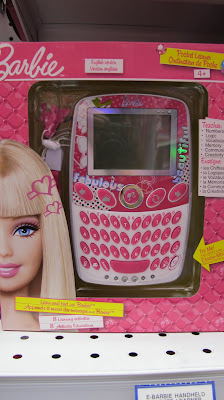
Nat and I took a stroll down the isles of Toys R US and we found that all the girls toys that were related to technology were located in the section with all the toys marketed toward boys, such as science and equipment for means of media production, such as this pink, electronic drum kit. Also, any technological toys were appropriated for girls, they were pink, flowery and represented as the "token technology". Girls being involved in technology is not the normal. While boys' telescopes, chemistry sets, and mock electronic gadgets look very close to the real thing, they are black or blue and simple, much like in real life, the girl- gadgets are glammed up, they are pink and decorated with flowers and graphics. Lipkin addresses this very socialization, appropriation, and gendering of children's toys. She explains how although gender coding runs strong for both sexes, gender-typing is much more restrictive for for boys than girls (2009, p.p. 9). Girls are assigned with the roles of physical beautification, cooking, cleaning, and having babies, and boys are assigned the jobs, working with tools and technology and earning money, and this was strongly reflected by the girls and boys toys Nat and I observed today. On one hand, girls were allowed to "cross-over" into the boy's realm, but these girl-adapted versions must be hot pink and flowery. Boys on the other hand, boys were not given this freedom. There were no dolls or cooking sets marketed toward boys, not even in blue.

What can be made of this? Although girls are given a measure of flexibility in terms of gender socialization however, the fact that technology-based toys had to be altered and "gussied-up" to suit girls means that girls in technology is not normal, it is a token circumstance. This socialization of children, via what is available to consumers in stores, has caused the slow raise of women and girls being involved in technology. This acts as a barrier to girls when pursuing technology and production of media, because they are not supposed to do it, they were not trained to be work with it, and therefore they are tokenized when they are involved in it.

In the real world, when little girls grow up, if you are a D.J., your decks are not going to be pink. In a standard laboratory, microscopes are not going to pink. In an office, the desktops are not going to pink. Is consumer culture subtly suggesting that girls interacting with technology is a fairy-tale or merely a game of pretend? The boy's world is the real world, the norm, and as reinforced by this pink plastic the message communicated to girls is that they do not belong there.
Glammed-up girl version of a Blackberry


Barbie's pink computer, good grief!

Tuesday, December 6, 2011

Response to the Sexy Tech-Girl Obsession


Look at these dolls, look at the sexualized poses, one with her leg in the air. Look at the scientist doll, with her doe eyes, blank, helpless stare and her sexualized body. I chose to post these pictures from Nat and I's adventure to the mall because it is the production of products like these that contributes to situations such as Jade Raymond's where girls in technology are given credit for their bodies and beauty rather than their technological skills.

The fruits of consumerism are so embedded in our culture and pervasive in girl's lives that the identity they breed becomes the identity girls perform or are expected to perform.

Friday, November 25, 2011

The Gendered Dialectic of Technology

So much analyzing media and so little producing it. This is a common theme in feminist studies; we critique, critique, critique, but don't offer an alternative. And why not? Perhaps its because we don't have the technological skills to do so... Many of us girls were never encouraged to learn media technologies, because it's not a "girl thing". So we're left overflowing with ideas, yet lacking the ability to disseminate them. It's interesting our that production technology, our communication and media technology, is largely dominated by men. Generally speaking, girls and women lack the technological skills, knowledge and perhaps even motivation to produce media and communicate publically. Why? Is it because girls and technology actually don't mix? Because they don't have anything to say? Or is that a master narrative in our society, a story that is told over and over, that permeates our institutions and discourses in such a way that it appears natural, inherent...? I argue it is the latter.

I am beginning to realize that this lack of technological skills and abilities in girls and women is part of what Luce Irigaray calls a phallogocentric economy, an economy of castration, an economy of lack. By this she means that women are signified, defined, by what they lack in relation to men. It is women's lack of a penis, lack of "rational thinking", lack of "production skills", lack of "power" that defines her. Men's power and higher social status is dependent, is contingent on what women lack. So to bring it all back together, the master narrative that girls and technology don't mix is a cultural story that keeps girls and women locked into a position of inferiority, of naturalized lack.

But, just like Hegel's master / slave relationship, men's supposed natural technological abilities are in a dialectical relationship with women's supposed natural inabilities. What happens if girls and women start touching the buttons, crossing the wires... ?? That's what we want to do here... we want to empower each other to master the skills many of us have long believed and accepted as purely boys and men's domain.

Thursday, November 24, 2011

A foot in the door, camera in hand...

Last May I had the incredible opportunity of participating in an intensive documentary film workshop with five other young women taught by a few very accomplished women in the film industry. We learned everything from stories, to sound, to camera equipment, to editing, to funding. The program is called the Kris Anderson Connexions Youth Forum, a collaboration between DOXA film festival in Vancouver and the NFB, and it is meant to help young female filmmakers get a foot in the door of a male dominated film industry.
This post was written by one of the young women participating in the 2011 Kris Anderson DOXA Youth Connexions Forum, as part of the DOXA Documentary Film Festival. “Connexions” is an immersive 2-week program where 6 selected emerging female filmmakers create 6 short films in 6 days, while also connecting with industry professionals & checking out all the doc films & panels.


The big moment had finally arrived. I stood on stage beside 5 brilliant aspiring filmmakers. We waited prettily in our party dresses and high heels to introduce our films to a sold-out house at the Rio Theatre. My friends and family filled the entire front row. Despite being blinded by the spotlight, I grinned at them proudly. My years of hard work had gotten me here. I could get used to this. The announcer began thanking sponsors and volunteers. I kept smiling.

Then the announcer turned his attention to us, the participants of the 6th annual Kris Anderson Connexions Youth Forum. But what he said made my stomach crunch and my feelings of excitement and anticipation curdle into confusion and smallness. “The Connexions Youth Forum is designed to help youth who face barriers in attaining their goals as documentary filmmakers…”

What!?! Barriers?? Really? And all this time I thought it was a program for talented young women. But I haven’t faced any barriers, I thought to myself. Actually quite the opposite. Through my privilege as a Canadian university student, making films found me, picked me up, and coddled me. I was troubled by this and continued thinking about it over the next few days.

Am I just a girl being given a chance to break through barriers? Or do I actually have talent as a filmmaker? This is a question that taunts many female artists. We are given special recognition for our womanhood, rather than for our art. The same goes for many artists of “marginalized” identities. We remain in special categories, we have our special shows, and are celebrated for our ‘different’ (non white male) identities.

I now realize the barriers I face are not obvious at the surface level. Women filmmakers are dealing with internalized barriers. Barriers arising out of the collective psyche that tell us women and technology don’t mix. Don’t touch those buttons, mind the wires, nevermind the lingo, you wouldn’t understand. It is the reason that in my youth I was an aspiring actress, not a filmmaker; a model, not photographer; a dancer, not a music producer. As a woman I am conditioned to see myself as an object of the public gaze, not as a cultural creator.

It is only in recent years, in the safety of academia (where I have always excelled), that I began touching the buttons, using technology as a medium to enhance research. But it was not until the incredible support I received in Connexions Youth Forum that I am now hoping to pursue documentary filmmaking as a career.

Throughout the Connexions program I felt empowered, excited, motivated and capable. Surrounded by incredible female mentors and peers, and equipped with a PD 150, a tripod, and a shotgun I broke through barriers that I had never even considered challenging.

So next year, if they decide to introduce the Connexions participants as ‘aspiring female filmmakers’ rather than ‘youth facing barriers’ (which skirts around entrenched sexism anyways…), this conversation about ‘barriers’ remains a necessary one. To address a problem such as sexism within the film industry we must recognize and name it. And although we must continue celebrating those who break through these barriers, we must not forget that their art is still art, and must to valued and integrated into mainstream culture as such.
—