Showing posts with label Critical Analysis. Show all posts

Wednesday, December 7, 2011

Girls just aren't interested in that sort of stuff.... riiiiigggghhhttttt.....

I’m sad today. I’m sad because of what I never knew, what my parents never knew, what my friends never knew, what most people go through their lives never knowing. We never knew that we are limiting children’s lives by socializing them in gender roles from the time they are born. We never knew that girls are socialized to consume and reproduce and display themselves, whereas boys are socialized to create and produce and use tools and adventure into the unnknown. The pink cap on the baby girl, the blue cap on the baby boy, and so we begin. We don’t even think about it, it’s just ‘the way it is’.

We at Girl Power 3.0 spent the day browsing through toy shops. We were looking for clues as to why we are so insecure about our relationships with technology. We found the exact same toys as when we were kids, however now that we have the tools to unpack what we see, everything has such a different meaning. The girls toys were princesses, dolls, tea sets, babies, laundry games, kitchens, puppy dogs, hair-do parlors, styling games, friendship jewels, toy houses, on and on and on. The boys toys were construction tools, rockets, cars, train sets, science kits, music production, space exploration, on and on and on.

As Lipkin (2009) comments, “few toys offered to girls offer intellectual challenges, emphasize exploration or adventure, assume leadership, or goad girls into action. This conditioning seeps in and in a world where the refrain ‘but all opportunities are open to girls now’ is heard, it’s important to think back to how messages (and which messages) are first imprinted and the preparation for what kinds of roles these toys serve (p.10).

For eight years now I’ve wanted to learn to dj, I’ve come so close so many times, but I still haven’t. When I was 18 I used to stand right up close to the dj both and watch him turn knobs and press buttons, trying to learn from observation. When I was 19 years old and living in New Zealand, I bought decks and mixer on ebay, but cancelled my payment at the last minute because I moved cities. Another time, a big time dj in Auckland offered to take me on as his apprentice, but after being sexually assaulted I left the country. I’ve been immersed in the electronic music culture for eight years now, I’m friends with dozens of DJs, music producers, sound techs, and mc’s, the VAST majority of whom are male, I’ve dated an array of them, and still, I have yet to learn for myself. Secretly, many of my girlfriends who dance on stages want to become DJs. We talk about it amongst ourselves – the kinds of music we would play, the way we would work together, the power and thrill of learning the skills – and still, none of us have.


But the world is 'open' to me, to us, we have every opportunity available, right??… so why aren’t we girls rockin dancefloors all over the world like our male friends? Well, before doing research for this project I didn’t really know why. I just thought it was my own fault for not trying hard enough, being committed enough... But something clicked today as I walked down the aisles of toys r us … From the time we are little girls, through the toys we play with and activities we are engaged in, we are subliminally indoctrinated not to produce, not to invent, not to create…

So, next year in 2012, I’m doing it. I’m going to campus radio and I’m going to learn how to use all the equipment. I’m going to get my own radio show. I’ve been afraid of failing for so long, afraid of confirming the stereotypes that girls don’t understand technology, afraid of not being able to create anything ‘good’… But fuck it. I'm going to learn, I'm going to make mistakes in public, and I'm going to get over it... And once I have some skills, I’m going to encourage all my girl friends to do the same, because we need us out there, we need each other making music, playing music, we need each other as role models and supporters, we need to hear each others brilliance, we need to create.

Just Because I'm a Girl doesn't Mean My Technology Has to be Pink


Boy version of an electronic drum kit


Girl version of an electronic drum kit
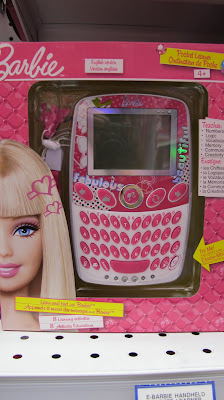
Nat and I took a stroll down the isles of Toys R US and we found that all the girls toys that were related to technology were located in the section with all the toys marketed toward boys, such as science and equipment for means of media production, such as this pink, electronic drum kit. Also, any technological toys were appropriated for girls, they were pink, flowery and represented as the "token technology". Girls being involved in technology is not the normal. While boys' telescopes, chemistry sets, and mock electronic gadgets look very close to the real thing, they are black or blue and simple, much like in real life, the girl- gadgets are glammed up, they are pink and decorated with flowers and graphics. Lipkin addresses this very socialization, appropriation, and gendering of children's toys. She explains how although gender coding runs strong for both sexes, gender-typing is much more restrictive for for boys than girls (2009, p.p. 9). Girls are assigned with the roles of physical beautification, cooking, cleaning, and having babies, and boys are assigned the jobs, working with tools and technology and earning money, and this was strongly reflected by the girls and boys toys Nat and I observed today. On one hand, girls were allowed to "cross-over" into the boy's realm, but these girl-adapted versions must be hot pink and flowery. Boys on the other hand, boys were not given this freedom. There were no dolls or cooking sets marketed toward boys, not even in blue.

What can be made of this? Although girls are given a measure of flexibility in terms of gender socialization however, the fact that technology-based toys had to be altered and "gussied-up" to suit girls means that girls in technology is not normal, it is a token circumstance. This socialization of children, via what is available to consumers in stores, has caused the slow raise of women and girls being involved in technology. This acts as a barrier to girls when pursuing technology and production of media, because they are not supposed to do it, they were not trained to be work with it, and therefore they are tokenized when they are involved in it.

In the real world, when little girls grow up, if you are a D.J., your decks are not going to be pink. In a standard laboratory, microscopes are not going to pink. In an office, the desktops are not going to pink. Is consumer culture subtly suggesting that girls interacting with technology is a fairy-tale or merely a game of pretend? The boy's world is the real world, the norm, and as reinforced by this pink plastic the message communicated to girls is that they do not belong there.
Glammed-up girl version of a Blackberry


Barbie's pink computer, good grief!

Tuesday, December 6, 2011

Jade Raymond: Hottest Game Producer or Producer of Hottest Game?

Jade Raymond is an executive producer of a very successful video game called Assassin's Creed. When I learned about her I turned to the google machine to find out more. I was surprised to see "Jade Raymond Maxim" come up as one of the top searches. Turns out she was not in Maxim, and states she never will be. It was a big rumour that spread like wildfire through the gaming world. Apparently there was even an x-rated comic made about her. One gamer blogger, Torrence Davis, notes how he has never seen any game producer get so much attention. Davis observed that her picture always accompanies any write up about Assassin's Creed and whenever the game is mentioned in online forums, men invariably starts discussing how "hot" Raymond is. To this Davis responds: "Shouldn’t we be making note that a woman produced one of the hottest games of the year? Shouldn’t we be complimenting her game producing skills and not the beauty that she’s been blessed with?"

It's wonderful news that this young woman is doing so well in the male dominated gaming industry. But what does it mean that she is constantly praised for her looks instead of her talent? What does it matter that she's 'hot'? Can we say that her position of executive producer represents "equality" for genders, or does the fact that Raymond is constantly reduced / idolized for her appearances suggest a much more pervasive inequality?

It's this kind of appearance based-judgment and sexualization of girls' bodies that prevent many women from entering positions of power. As Elline Lipkin (2009) expresses in chapter 2 of her book Girls Studies, many girls experience self-consciousness from a very young age as a result of an "onslaught of images of impossibly perfect-looking, sexually contextualized female bodies" (p.42) in popular media. The fear of being sexually objectified and judged in the public sphere is a very real threat that prevents many of us from entering male dominated work spaces. I experienced this for the first time working in the shop department of a high end car dealership in a New Zealand. Without any feminist analytical skills to help me understand the situation, I resigned from an amazing position as it upset me so much to be objectified by my (male) co-workers in such sexualized ways. Without a critical understanding of how this shapes our experiences, we are prone to internalize sexual objectification, thereby limiting our own potential by building our lives in ways to avoid recurrence of such experiences.

Response to the Sexy Tech-Girl Obsession


Look at these dolls, look at the sexualized poses, one with her leg in the air. Look at the scientist doll, with her doe eyes, blank, helpless stare and her sexualized body. I chose to post these pictures from Nat and I's adventure to the mall because it is the production of products like these that contributes to situations such as Jade Raymond's where girls in technology are given credit for their bodies and beauty rather than their technological skills.

The fruits of consumerism are so embedded in our culture and pervasive in girl's lives that the identity they breed becomes the identity girls perform or are expected to perform.

Friday, December 2, 2011

Interview with blogger Majestic Legay


Girl Power 3.0 interviewed master blogger and feminist activist Majestic Legay about their relationship with technology. Read more about Legay's blogs at That's So Majestic and Glitter Politic.


GP3: Please tell us your relationship with technology. For example, what field are you in? or How do you use technology in your spare time?


ML: I use the internet to blog about body politics, queer identity, whiteness and decolonization and love.


GP3: If you have a good relationship with technology, how did you forge this? What experiences provided you with the tools to feel confident using technology?

ML: I mean, I just always had access to a computer growing up, and I saw the internet as a way to have a voice. Newer blogging websites like Tumblr strive to be very user friendly, so I just saw that other people were doing it and jumped right in!


GP3:What barriers did you face,if any, due to your gender or gender stereotypes?

ML: I would say there were few barriers that stopped me from accessing the internet due to my gender, but that gender is a white and western one so perhaps that is why.


GP3: How, if at all, is technology tied into your identity? ie. Identity production...

ML:I talk a lot about identity politics and identity online. I started out my blog as “innerfatgirl” and was welcomed into the ‘fat acceptance’ community, which on Tumblr is largely white women. Coming out as trans/gender queer really changed that but it also opened me to new political online communities that I wasn’t as much a part of before.


GP3: What, in you opinion, prevent girls from accessing or feeling confident using/producing technology?

ML: I think just the notion that women/those socialized as women don’t have a voice or something to say. For me, my blog has given me a voice which has encouraged other people to use their voices in their own ways that make them feel strong. Getting over the fear you have nothing important to say is a fear many people I know who are women or were socialized women face.

GP3: What message would you give to girls today about pursuing technology or computer based fields?

ML: I really don’t know a ton about technology/computer based fields. I’d say fake it till you make it.


So there you have our survey results from Magestic Legay. I personally LOVE this Tumblog. We wanted to include Magestic in our project as a person who uses the internet to engage in queer-girl politics. As someone that uses the internet to speak their voice, and someone who considers this to be an online community-contributing regularly Magestic's story was so important for us to highlight. This is a perfect example of queer identity production via internet ie. Girl produced media. Just as in Susan Driver's book, Queer Girls in Popular Culture: reading, resisting and creating media, the internet provides an alternative to mainstream, mass media messages about heternormative girlhoods being the norm. These sites provide a place to resignify and reread narratives about sexuality and girls lived realities. They expand the options of media performativity and complicate embodied images available to girls. Instead of queer representation being exploited and appropriated by the skinny, white girls we see kissing on teen dramas as of late, we see a step back from comodification and enter the realm of 'talking back' to media representations. Instead this area of the internet is reserved for opposition to institutional images of girls. We see queer girls engagement with and resistance of popculture. And it is awesome!
Thank you Magestic!

Tuesday, November 29, 2011

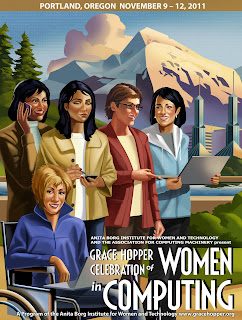
LOVE THESE POSTERS!!!!


Who would of knew, eh? A poster for international computing conferences with all women.. Amazing! And not just (stereo)typical white, able-bodied, western, subtly "sexy" business women either, but an array of racial backgrounds, styles, and body-mobility.

I've got a problem: Blogging and Bedroom Culture

I noticed the very groomed and potentially airbrushed photoshoots of girls using technology in their bedrooms: and this is my resistance to it!

I blog from my bedroom. I always have, and in this particular instance, I am ready for bed and in my pajamas!

This is the reality of blogging-You can do it from anywhere and it is not restricted to business hours and does not require a uniform. I share information, ideas, photos, opinions and recipes online all the time. The fact is, I can do this from the comfort of my home-I can make money, produce content, contribute to the web, and create a space for myself in the 'public sphere' from my 'private sector'. This blurs the boundaries of the public/private divide that has been asserted to why research on girls has been only recently established.

I assert that the popularity and prevalence of internet technology in the home is a huge step in the direction of girls creating their own presences in very public ways in the very publicly accessible domain of cyberspace. Girls are literally creating space for themselves and for their realities through contributions to blogs, online zines, in their comments of links and participation in online gaming. This space is progress. It is empowered. It is girls engaged! And in relation to our Driver reading, the internet is a place to find alternative messages about girlhoods, the bedroom where these messages are both produced and consumed; a contrast to television where girls are only the consumer, and in no way in control of making the messages about girls and their experiences. The internet technology available is a venue to talk back to messages and popular constructs girls, by girls for girls.

Blogging is both valid and valuable.

Blogging happens! And it happens in my bedroom! I am not being sexualized, I am being subjective! We are creating inclusive alternatives for girls that they, themselves can contribute to, and it is all done from the comfort of my room!
Pretty powerful position to be in, if you ask me!

Girls, Technology and Bedroom Culture


“Bedroom Culture” is the name given to nature of girls’ lives, which prevented the advancement of the academic study of girls. In the past, and in many ways still to this day, girls involvement in society was confined to the private sphere, they remained at home learning domestic trades while boys engaged in the public sphere by being involved in the education system and the “outside world”. This caused barriers for scholars who wanted to study girls and many found it difficult to locateand comprehend the agency of girls (Driscoll, 2008, p.p. 21).

Bedroom culture among girls has continued to this day, but this bedroom culture is driven by the vehicle of technology. Many girls have powerful views on politics, rights, justice and the like and they express it to their friends on facebook, text it to their friends on their phones, and email it to their teachers, but they do not blog or make their thoughts for public access. Many girls express themselves on

Skype, or web cam, or on short videos done on their desktop computers, but only their friends and family ever see it. Many girls sing to brush in front of there mirrors, play their guitars on their beds, or compose their original music on Garage Band, but they

never put their music up on public sites or become D.J.’s. This is bedroom culture, all of this can be done from the comfort of the bedroom, the private sphere.

Why then do we want to encourage girls to make their opinions, movies, and music, expressed through technology, public? Because we value girls voices and believe the world needs to hear them. We believe this technological bedroom culture has starved the public of an equal representation of what needs to be said. Girls voices tend to be a minority in terms of what is represented in technology but they are not a minority in terms of the population of the world. Let's bring the girls ideas out of the bedroom and into the public!

INTERNET DISRUPTED!!!

We also want to disrupt the internet and technological public sphere. The pictures I show around this post are results from a Google image search of girls and their relationship with technology. What do we typically see? Smiling, pink, middle-class, mostly white, happy girls whose family can afford to get them their own laptop at age eight. Where are the queer girls? Where are the girls of ethnic minorities? Where are the girls of lower class engaging in technology? We want all girls to make their technological endeavors public so ALL girls are represented not just the "pretty" ones the internet wants us to see.

C. Driscoll. 2008. Girls Today: Girls, girl culture and girls studies, Journal of Girlhood Studies, Summer 1(1) 13-32

Terri Oda, Debunking Biology

How does biology explain the low numbers of women in computer science? Hint: it doesn't.
View more presentations from Terri Oda
This is reposted from SlideShare.
This post proves the idea that women are not as good as math, and therefore computer science, is false. Ideas like these have been supported in the past by biology and other sciences, and even though many of the studies have been exposed as biased or sexist, there findings can still perpetuate today in to explain the differences in the percentages and participation of women in certain male dominated fields.
These constructions of girls and women were detailed in Nancy Lesko's article Past, Present and future concept of Adolescence, showing the shifts in discourse and accepted beliefs in relation to time period and scientific field of study. She traced the paths to a more accurate and inclusive discourse of 'girlhoods' and this presentation supports Lesko's stance on the drawbacks of discourse based on biology while refuting wrongly applied data to explain stereotypes supported by science.
My critique of this slide presentation is that it does not offer a feminist critique, nor does it attempt to explain why the numbers show there are less girls represented in the computer sciences field.


However, this slideshow does reveal a disconect between the reality of girls’ skills and potential to engage in technology and the socially constructed portrayal of girls’ potential.

“For, example, anthropologists Yanigasako and Collier (1990) argue that inquireies into childbearing and child rearing as socially constructed in particular historical situations are fundamentally undermined by the assumed natural biological division between women who bear children and men who do not. Yanigasako and Collier discuss how an acceptance of the nature/cultural division in anthropological theory and research is concomitant with an acceptance of biology as universal, outside of cultural influences, and with inevitable social consequences for gendered divisions of labour. They argue that in not examining how biological sex differences are socially constructed, feminist theory ultimately is undermined by these biological differences” (Lesko, 1996, p p. 143).

Therefore, we, girl power 3.0 will refuse to let our feminist theory be undermined but not drawing attention to how socially constructions based on biology has limited girls involovment in technology, specifically computer sciences!! Girls, statistically are just as capable of the level of math required for computer sciences as boys. They have the skills, so innate biological factors to not get in their way. However, what does limit girls’ involvement in computer sciences is how computing jobs have been culturally portrayed as a boy’s club. When girls think of computer sciences employees most envision a nerdy White or Asian male typing away at computer desk, when this does not have to be the case. We, girl 3.0 aim to debunk this myth and attack these social constructions to help other girls, and even ourselves as girls feel more comfortable about engaging with computers in the professional realm.


Sunday, November 27, 2011

Girls in a Tech World

Quote from the above movie: "If we don't have women designing the products we use, then it's just going to turn into boys toys that has nothing to do with anything we care about."

This quote draws on Kearny's concept of the "girl gaze" (Lipkin, 2009, p.p. 152-153). Using a girl gaze, instead of a male gaze, challenges the hegemonic power relations around production and consumption. It allows girls to create products for girls that resist the temptation of reproducing products that support normative and hetero-normative values, that are normally produced by males for female consumption. These girls in this short clip utilize this girl gaze, and our version of girl power re-vamped (girl power 3.0) to create technological products for girls, by girls in a male-dominated technological world.

Friday, November 25, 2011

The Gendered Dialectic of Technology

So much analyzing media and so little producing it. This is a common theme in feminist studies; we critique, critique, critique, but don't offer an alternative. And why not? Perhaps its because we don't have the technological skills to do so... Many of us girls were never encouraged to learn media technologies, because it's not a "girl thing". So we're left overflowing with ideas, yet lacking the ability to disseminate them. It's interesting our that production technology, our communication and media technology, is largely dominated by men. Generally speaking, girls and women lack the technological skills, knowledge and perhaps even motivation to produce media and communicate publically. Why? Is it because girls and technology actually don't mix? Because they don't have anything to say? Or is that a master narrative in our society, a story that is told over and over, that permeates our institutions and discourses in such a way that it appears natural, inherent...? I argue it is the latter.

I am beginning to realize that this lack of technological skills and abilities in girls and women is part of what Luce Irigaray calls a phallogocentric economy, an economy of castration, an economy of lack. By this she means that women are signified, defined, by what they lack in relation to men. It is women's lack of a penis, lack of "rational thinking", lack of "production skills", lack of "power" that defines her. Men's power and higher social status is dependent, is contingent on what women lack. So to bring it all back together, the master narrative that girls and technology don't mix is a cultural story that keeps girls and women locked into a position of inferiority, of naturalized lack.

But, just like Hegel's master / slave relationship, men's supposed natural technological abilities are in a dialectical relationship with women's supposed natural inabilities. What happens if girls and women start touching the buttons, crossing the wires... ?? That's what we want to do here... we want to empower each other to master the skills many of us have long believed and accepted as purely boys and men's domain.

Thursday, November 24, 2011

A foot in the door, camera in hand...

Last May I had the incredible opportunity of participating in an intensive documentary film workshop with five other young women taught by a few very accomplished women in the film industry. We learned everything from stories, to sound, to camera equipment, to editing, to funding. The program is called the Kris Anderson Connexions Youth Forum, a collaboration between DOXA film festival in Vancouver and the NFB, and it is meant to help young female filmmakers get a foot in the door of a male dominated film industry.
This post was written by one of the young women participating in the 2011 Kris Anderson DOXA Youth Connexions Forum, as part of the DOXA Documentary Film Festival. “Connexions” is an immersive 2-week program where 6 selected emerging female filmmakers create 6 short films in 6 days, while also connecting with industry professionals & checking out all the doc films & panels.


The big moment had finally arrived. I stood on stage beside 5 brilliant aspiring filmmakers. We waited prettily in our party dresses and high heels to introduce our films to a sold-out house at the Rio Theatre. My friends and family filled the entire front row. Despite being blinded by the spotlight, I grinned at them proudly. My years of hard work had gotten me here. I could get used to this. The announcer began thanking sponsors and volunteers. I kept smiling.

Then the announcer turned his attention to us, the participants of the 6th annual Kris Anderson Connexions Youth Forum. But what he said made my stomach crunch and my feelings of excitement and anticipation curdle into confusion and smallness. “The Connexions Youth Forum is designed to help youth who face barriers in attaining their goals as documentary filmmakers…”

What!?! Barriers?? Really? And all this time I thought it was a program for talented young women. But I haven’t faced any barriers, I thought to myself. Actually quite the opposite. Through my privilege as a Canadian university student, making films found me, picked me up, and coddled me. I was troubled by this and continued thinking about it over the next few days.

Am I just a girl being given a chance to break through barriers? Or do I actually have talent as a filmmaker? This is a question that taunts many female artists. We are given special recognition for our womanhood, rather than for our art. The same goes for many artists of “marginalized” identities. We remain in special categories, we have our special shows, and are celebrated for our ‘different’ (non white male) identities.

I now realize the barriers I face are not obvious at the surface level. Women filmmakers are dealing with internalized barriers. Barriers arising out of the collective psyche that tell us women and technology don’t mix. Don’t touch those buttons, mind the wires, nevermind the lingo, you wouldn’t understand. It is the reason that in my youth I was an aspiring actress, not a filmmaker; a model, not photographer; a dancer, not a music producer. As a woman I am conditioned to see myself as an object of the public gaze, not as a cultural creator.

It is only in recent years, in the safety of academia (where I have always excelled), that I began touching the buttons, using technology as a medium to enhance research. But it was not until the incredible support I received in Connexions Youth Forum that I am now hoping to pursue documentary filmmaking as a career.

Throughout the Connexions program I felt empowered, excited, motivated and capable. Surrounded by incredible female mentors and peers, and equipped with a PD 150, a tripod, and a shotgun I broke through barriers that I had never even considered challenging.

So next year, if they decide to introduce the Connexions participants as ‘aspiring female filmmakers’ rather than ‘youth facing barriers’ (which skirts around entrenched sexism anyways…), this conversation about ‘barriers’ remains a necessary one. To address a problem such as sexism within the film industry we must recognize and name it. And although we must continue celebrating those who break through these barriers, we must not forget that their art is still art, and must to valued and integrated into mainstream culture as such.
—