Showing posts with label girls and technology. Show all posts

Wednesday, December 7, 2011

Just Because I'm a Girl doesn't Mean My Technology Has to be Pink


Boy version of an electronic drum kit


Girl version of an electronic drum kit
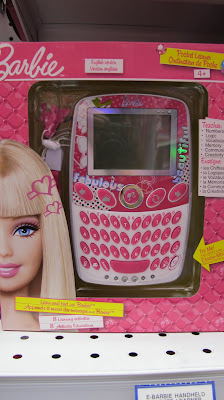
Nat and I took a stroll down the isles of Toys R US and we found that all the girls toys that were related to technology were located in the section with all the toys marketed toward boys, such as science and equipment for means of media production, such as this pink, electronic drum kit. Also, any technological toys were appropriated for girls, they were pink, flowery and represented as the "token technology". Girls being involved in technology is not the normal. While boys' telescopes, chemistry sets, and mock electronic gadgets look very close to the real thing, they are black or blue and simple, much like in real life, the girl- gadgets are glammed up, they are pink and decorated with flowers and graphics. Lipkin addresses this very socialization, appropriation, and gendering of children's toys. She explains how although gender coding runs strong for both sexes, gender-typing is much more restrictive for for boys than girls (2009, p.p. 9). Girls are assigned with the roles of physical beautification, cooking, cleaning, and having babies, and boys are assigned the jobs, working with tools and technology and earning money, and this was strongly reflected by the girls and boys toys Nat and I observed today. On one hand, girls were allowed to "cross-over" into the boy's realm, but these girl-adapted versions must be hot pink and flowery. Boys on the other hand, boys were not given this freedom. There were no dolls or cooking sets marketed toward boys, not even in blue.

What can be made of this? Although girls are given a measure of flexibility in terms of gender socialization however, the fact that technology-based toys had to be altered and "gussied-up" to suit girls means that girls in technology is not normal, it is a token circumstance. This socialization of children, via what is available to consumers in stores, has caused the slow raise of women and girls being involved in technology. This acts as a barrier to girls when pursuing technology and production of media, because they are not supposed to do it, they were not trained to be work with it, and therefore they are tokenized when they are involved in it.

In the real world, when little girls grow up, if you are a D.J., your decks are not going to be pink. In a standard laboratory, microscopes are not going to pink. In an office, the desktops are not going to pink. Is consumer culture subtly suggesting that girls interacting with technology is a fairy-tale or merely a game of pretend? The boy's world is the real world, the norm, and as reinforced by this pink plastic the message communicated to girls is that they do not belong there.
Glammed-up girl version of a Blackberry


Barbie's pink computer, good grief!

Friday, December 2, 2011

Interview with blogger Majestic Legay


Girl Power 3.0 interviewed master blogger and feminist activist Majestic Legay about their relationship with technology. Read more about Legay's blogs at That's So Majestic and Glitter Politic.


GP3: Please tell us your relationship with technology. For example, what field are you in? or How do you use technology in your spare time?


ML: I use the internet to blog about body politics, queer identity, whiteness and decolonization and love.


GP3: If you have a good relationship with technology, how did you forge this? What experiences provided you with the tools to feel confident using technology?

ML: I mean, I just always had access to a computer growing up, and I saw the internet as a way to have a voice. Newer blogging websites like Tumblr strive to be very user friendly, so I just saw that other people were doing it and jumped right in!


GP3:What barriers did you face,if any, due to your gender or gender stereotypes?

ML: I would say there were few barriers that stopped me from accessing the internet due to my gender, but that gender is a white and western one so perhaps that is why.


GP3: How, if at all, is technology tied into your identity? ie. Identity production...

ML:I talk a lot about identity politics and identity online. I started out my blog as “innerfatgirl” and was welcomed into the ‘fat acceptance’ community, which on Tumblr is largely white women. Coming out as trans/gender queer really changed that but it also opened me to new political online communities that I wasn’t as much a part of before.


GP3: What, in you opinion, prevent girls from accessing or feeling confident using/producing technology?

ML: I think just the notion that women/those socialized as women don’t have a voice or something to say. For me, my blog has given me a voice which has encouraged other people to use their voices in their own ways that make them feel strong. Getting over the fear you have nothing important to say is a fear many people I know who are women or were socialized women face.

GP3: What message would you give to girls today about pursuing technology or computer based fields?

ML: I really don’t know a ton about technology/computer based fields. I’d say fake it till you make it.


So there you have our survey results from Magestic Legay. I personally LOVE this Tumblog. We wanted to include Magestic in our project as a person who uses the internet to engage in queer-girl politics. As someone that uses the internet to speak their voice, and someone who considers this to be an online community-contributing regularly Magestic's story was so important for us to highlight. This is a perfect example of queer identity production via internet ie. Girl produced media. Just as in Susan Driver's book, Queer Girls in Popular Culture: reading, resisting and creating media, the internet provides an alternative to mainstream, mass media messages about heternormative girlhoods being the norm. These sites provide a place to resignify and reread narratives about sexuality and girls lived realities. They expand the options of media performativity and complicate embodied images available to girls. Instead of queer representation being exploited and appropriated by the skinny, white girls we see kissing on teen dramas as of late, we see a step back from comodification and enter the realm of 'talking back' to media representations. Instead this area of the internet is reserved for opposition to institutional images of girls. We see queer girls engagement with and resistance of popculture. And it is awesome!
Thank you Magestic!