Friday, December 2, 2011

Interview with blogger Majestic Legay


Girl Power 3.0 interviewed master blogger and feminist activist Majestic Legay about their relationship with technology. Read more about Legay's blogs at That's So Majestic and Glitter Politic.


GP3: Please tell us your relationship with technology. For example, what field are you in? or How do you use technology in your spare time?


ML: I use the internet to blog about body politics, queer identity, whiteness and decolonization and love.


GP3: If you have a good relationship with technology, how did you forge this? What experiences provided you with the tools to feel confident using technology?

ML: I mean, I just always had access to a computer growing up, and I saw the internet as a way to have a voice. Newer blogging websites like Tumblr strive to be very user friendly, so I just saw that other people were doing it and jumped right in!


GP3:What barriers did you face,if any, due to your gender or gender stereotypes?

ML: I would say there were few barriers that stopped me from accessing the internet due to my gender, but that gender is a white and western one so perhaps that is why.


GP3: How, if at all, is technology tied into your identity? ie. Identity production...

ML:I talk a lot about identity politics and identity online. I started out my blog as “innerfatgirl” and was welcomed into the ‘fat acceptance’ community, which on Tumblr is largely white women. Coming out as trans/gender queer really changed that but it also opened me to new political online communities that I wasn’t as much a part of before.


GP3: What, in you opinion, prevent girls from accessing or feeling confident using/producing technology?

ML: I think just the notion that women/those socialized as women don’t have a voice or something to say. For me, my blog has given me a voice which has encouraged other people to use their voices in their own ways that make them feel strong. Getting over the fear you have nothing important to say is a fear many people I know who are women or were socialized women face.

GP3: What message would you give to girls today about pursuing technology or computer based fields?

ML: I really don’t know a ton about technology/computer based fields. I’d say fake it till you make it.


So there you have our survey results from Magestic Legay. I personally LOVE this Tumblog. We wanted to include Magestic in our project as a person who uses the internet to engage in queer-girl politics. As someone that uses the internet to speak their voice, and someone who considers this to be an online community-contributing regularly Magestic's story was so important for us to highlight. This is a perfect example of queer identity production via internet ie. Girl produced media. Just as in Susan Driver's book, Queer Girls in Popular Culture: reading, resisting and creating media, the internet provides an alternative to mainstream, mass media messages about heternormative girlhoods being the norm. These sites provide a place to resignify and reread narratives about sexuality and girls lived realities. They expand the options of media performativity and complicate embodied images available to girls. Instead of queer representation being exploited and appropriated by the skinny, white girls we see kissing on teen dramas as of late, we see a step back from comodification and enter the realm of 'talking back' to media representations. Instead this area of the internet is reserved for opposition to institutional images of girls. We see queer girls engagement with and resistance of popculture. And it is awesome!
Thank you Magestic!

Thursday, December 1, 2011

Surveying the situation....

Check out Anonymous Advertising here!
We are fortunate to have interviewed a Tech Girl local to Victoria. We wondered what it is like in a world where girls are competent and confident with their technology, so we sent a survey along to Aleya a talented business owner to provide some insight into her lived experience as a female in the Tech World. We at Girl Power 3.0 thank her for her contributions to our Blog about Girls inspiring Girls and inspired by Girls to touch the buttons! She certainly does, so please read more about Aleya!

Girl Power 3.0: Please tell us your relationship with technology. For example, what field are you in? or How do you use technology in your spare time?
I ‘m an art director and web/digital content developer. I rely on technology as much for my livelihood as my social network and it’s a big enough part of my life that I loose sleep and experience some initial anxiety when access to my computer, iPhone and the internet is limited. I’m not super proud of this.

GP3: If you have a good relationship with technology, how did you forge this? What experiences provided you with the tools to feel confident using technology?
I consider my use of technology to be pretty key to my having overcome a lot of social anxiety and lack of self-esteem It’s also key to my ability to build a competitive skill set in my field. I’ve mostly taken advantage of the passive opportunities – like learning skills required for creative disciplines online where I’m not held back from experimenting by my reluctance to have have my initial attempts on display. It’s has been key to my developing a critical professional network that I wouldn’t have had the confidence to put together in-person.

GP3: What barriers did you face,if any, due to your gender or gender stereotypes?
When I first began working in the advertising/design field in New York as a graduate fresh out of school I was in almost every company I worked for, the only female on staff in the creative department. With the exception of one agency that was owned and run by three female partners, the creative departments were generally staffed by men (young and old), the IT departments were staffed by men and the account management department (responsible for coddling clients) was largely staffed by females deemed better equipped to handle business men and CEOs of varying temperments.
Several things made me realize the gender stereotypes at work:
Despite being employed as the senior art director I was often mistaken for an accounts person.
In meetings and presentations, it was not uncommon for new clients to display a look of concern when introduced to me as the art director on their account than they would with the male designer with 5-10 years less experience.
On more than one occasion I was told I designed like a man. I have yet to figure out what the hell that means.

GP3: How, if at all, is technology tied into your identity? ie. Identity production...
I’m in a field where the tools being used change and advance at a ridiculously rapid rate. Being able to stay on top of the latest technology available to you and giving yourself space and time to grow familiar enough with it to harness it for your own work and creative expression often becomes a part of my profession that’s really only realistic to men in the field once we reach the age that women’s spare time is more invested in finding a partner, nurturing a new relationship or raising children.

Having chosen the more typical “male” path in my field, I’m once again finding myself amongst fewer and fewer females invested in staying relevant and up-to-date. I’m starting to see that being a female in the field is once again becoming a key part of how I’m identified by others whether I like it or not.
Some times I struggle with this sometimes I use it to my advantage. Mostly I wish it wasn’t in the way of how people evaluate what I do.

GP3:vWhat, in you opinion, prevent girls from accessing or feeling confident using/producing technology?
I think I can really only speak for myself on this one. In my case it wasn’t so much my own giving into some really out dated stereotypes about what genders are best suited technology-based fields as it was those around me I relied on for support and reassurance. There’s far too much subconscious programming that happens to a person well-before a kid has developed the agency required to make their own decisions about their plans for their life’s work. Particularly in the field of technology, where there is already a culture of worshipping the newest and latest (in computers, etc.) it takes a certain amount of self-confidence to feel competent and worthy of being given access to these “magical” things.

GP3: What message would you give to girls today about pursuing technology or computer based fields?
The field is ENTIRELY LEVELLED!!!!!! Think sprawling bazaar of wonderful, accessible opportunities to sample rather than towering cathedral to carefully climb. The biggest factor in people’s success with technology has less to do with the opportunities presented or made available to them and more to do with how willing they are to put themselves out there. Anyone that thinks it’s un-ladylike to be willing to put themselves out there and promote themselves will be hurting themselves.

GP3; Can you recommend us any other links about girls creating media or producing technology? How about Programs you may know of for girls trying to get into such a field?
This event has become a huge success locally and gets tremendous participation from women in some creative and technology related fields. My guess it has something to do with the absence of men.
OUR EVENT!!!!
While we struggle to find female presenters that are confident and willing, we think we’ve had a hand in introducing some pretty talented women to the local professional community at our PechaKucha Night. Myself and Amanda Smith are the organizers and recruiters:


Aleya has had a hand in introducing technologically savvy, talented women to the professional community and we are so pleased to have introduced her to you! Thank you Aleya for an insightful and inspiring look into your place of work/world. If you would like to share your relationship with technology with us, please send us an email to receive your survey as engaginggirlhoodsproject@gmail.comhttp://www.anonymousadvertising.com/index.php

Wednesday, November 30, 2011

Meeting Logs

Thursday, November 17, 2011 5:00 – 6:20 pm
  • News of project change and brainstorming for new ideas
  • Ideas: Missing Girls? Or representation of girls in media
Tuesday, November 22, 5:30 – 6:30 pm
  • Mind mapping/brain storming
  • Decision to ditch girls & pregnancy and interrogate gilrs’ relationships with technology
  • Notes on approaches and relevant readings
Wednesday, November 23, 6:30 – 7:00 pm
  • Meeting with Joanne
  • Quick group debrief
  • Oral presentation, check-in and progress report
Tuesday, November 29, 5:30-8:00 pm
  • Organized class presentation
  • Posting Blogs and reflections
  • Took pictures
Saturday, November 26, 5:00-10:45 pm
  • Set-up group email address
  • Made survey questions
  • Designed blog
  • Created picture for header
  • Learned how to post on blog
  • Made plans for next meeting
Wednesday, November 30, 2:00-3:00 pm
  • Wrote outline for presentation
  • Overview of who will speak, what to discuss, which analysis to mention

Monday, December 5, 2:00-6:00 pm
Whitney and Erin
  • Went through and formatted all references
  • Showed Whitney how to make a menu tab to put references in
  • Discussed when to meet next-Wednesday to go through all post to confirm analysis content is satisfied
  • Assigned tasks-Erin update meeting post, start acknowledgements section, Whitney-putting her analytical comments into post form instead
Tuesday, December 6, 9:00-11:00 pm
  • Finished Acknowledgements and Meeting Log
  • Posted interviews
  • Continued to include analysis
Wednesday, December 7, 3:00-11:00 pm
  • Whitney and Nat went to mall and took photos of the toy isles and the gendered shopping spaces
  • 4 pm We all met, Published new post with findings, analysis and edited pictures
  • Worked on learning reflections and analysis
  • Wrote group statement
  • Ate pizza and listened to Nathalie's rap! Amazing
  • Planned next meeting
  • Mind mapped final analysis to link each post to the purpose of the project
  • Updated meeting log
Thursday, December 8, 5:00-....
  • Met at Erin's
  • Analysis
  • Group evaluation
  • Big Hug
  • Off to Pecha Kucha night to see some women in the music industry!

AMAZING OPPORTUNITY FOR GIRLS TO TALK BACK !!!

*Repost from Young Feminist Wire, my new favourite website!! Original available at:http://yfa.awid.org/2011/11/call-for-participation-in-young-feminist-blogathons-share-your-activist-story/


Submitted by Nelly on 28/11/2011

Call for Submissions: Young Feminist Blogathons – Deadline extended to December 5th!


There is still time to send in your last minute submissions to the Young Feminist Blogathons. Deadline has been extended until December 5th! Hurry up and Submit – we are looking forward to it.

The Young Feminist Wire is calling young women writers, bloggers and activists to submit blogs and/or videos on TWO themes this month. The first theme is Use of Social Media for Social Change and the other theme is Young Women on the Girl Effect. You can choose to submit your blogs/videos to ONE or BOTH themes by answering the questions provided. Please see below for descriptions on both themes including guiding questions and guidelines for submissions. DEADLINE for receiving submissions is November 27th, 2011!

Looking forward to receiving many submissions from young women!


1) USE OF SOCIAL MEDIA FOR SOCIAL CHANGE

Social media tools such as Twitter, Facebook, and blogs have exploded amongst young activists especially with the increase of internet accessibility in the last few years. Many young activists and organizers have used these mediums to rally support and spread awareness on social justice. On the one hand, the Arab uprisings have even been dubbed by some media as the Facebook and Twitter revolutions. On the other hand, the safety and security of online social media tools have been put to question with recent State crackdown on youth bloggers and internet censorship in Iran, Cuba and China. The debate on social media reached new heights when a Syrian Lesbian blogger was found to be an English man.

If you have used social media as a young feminist activist in your organizing, we want to hear your story.

How has social media helped you in organizing? How have identity politics and social ethics translated into the online world? How can social media benefit or harm women’s rights organizing?

Tell us about an organizing experience you have had that used social media to create social change. Did it work? What were the challenges? What advice do you have for other young feminist activists using social media in their organizing?

AND/OR

2) YOUNG WOMEN ON ‘INVESTING IN GIRLS’

Around the world, governments, donors, the UN, non-governmental organizations, financial institutions, corporations and the media alike are claiming that the solution to a wide range of the world’s problems is to invest in young women and girls. The Nike Foundation campaign on the Girl Effect, and Plan International’s Because I am a Girl campaign are just two examples of this growing trend. On the one hand, the growing focus on young women and girls presents important opportunities for the advancement of young women’s rights with increased attention and resources available for work with young women and girls. On the other hand, the investing in girls approach is often weak in its rights-based analysis and mostly tends to look at women and girls as an untapped resource for the advancement of their communities and societies.

If you are a young women activist who feels strongly about this trend, we want to hear your thoughts!

Tell us about your initial reactions to the Girl Effect and the Clock is Ticking videos. How are young women and girls portrayed in the videos? How is the “investing in girls” trend impacting the way people perceive young women and girl’s rights in your context? How is this trend affecting the work carried out to advance the rights of young women and girls? Does this influence what kinds of initiatives get funded or types of work that gets implemented? What are the opportunities and threats presented by this trend in your context? How are young women activists in your context responding to the trend?

How to participate

Simply, tell us your activist story through either a written blog post or short video. Refer to the submission guidelines below.

Click “Young Feminist Blogathon” to find out how to enter & see other great content from Young Feminist Wire!

We posted this to share the opportunity to contribute to the production of knowledge by girls! Enjoy.

Tuesday, November 29, 2011

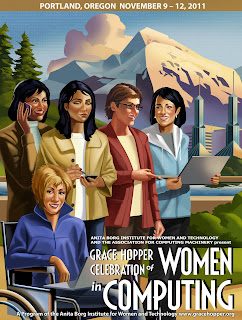
LOVE THESE POSTERS!!!!


Who would of knew, eh? A poster for international computing conferences with all women.. Amazing! And not just (stereo)typical white, able-bodied, western, subtly "sexy" business women either, but an array of racial backgrounds, styles, and body-mobility.

Reflections

Welcome to the reflexive part of our blog!
Here you can read our personal reflections, throughout the process of our Engaging Girls Project.
From our initial thoughts or hesitations, to our thought processes and frustrations, you will find our individual journal style entries from planning to implementing.
This process has not been a linear one, as we are constantly developing it, improving upon in and critically engaging with the content simultaneously.

Subjectivity plays both an important role in Girls Studies and in life, so we cherish the opportunity to dedicate a section of our learning process to this empowering practise. This enables us to have a record of how much we have grown during this project; how we as students and friends have developed alongside our assignment and as a result of it.

Enjoy our Reflections!

I've got a problem: Blogging and Bedroom Culture

I noticed the very groomed and potentially airbrushed photoshoots of girls using technology in their bedrooms: and this is my resistance to it!

I blog from my bedroom. I always have, and in this particular instance, I am ready for bed and in my pajamas!

This is the reality of blogging-You can do it from anywhere and it is not restricted to business hours and does not require a uniform. I share information, ideas, photos, opinions and recipes online all the time. The fact is, I can do this from the comfort of my home-I can make money, produce content, contribute to the web, and create a space for myself in the 'public sphere' from my 'private sector'. This blurs the boundaries of the public/private divide that has been asserted to why research on girls has been only recently established.

I assert that the popularity and prevalence of internet technology in the home is a huge step in the direction of girls creating their own presences in very public ways in the very publicly accessible domain of cyberspace. Girls are literally creating space for themselves and for their realities through contributions to blogs, online zines, in their comments of links and participation in online gaming. This space is progress. It is empowered. It is girls engaged! And in relation to our Driver reading, the internet is a place to find alternative messages about girlhoods, the bedroom where these messages are both produced and consumed; a contrast to television where girls are only the consumer, and in no way in control of making the messages about girls and their experiences. The internet technology available is a venue to talk back to messages and popular constructs girls, by girls for girls.

Blogging is both valid and valuable.

Blogging happens! And it happens in my bedroom! I am not being sexualized, I am being subjective! We are creating inclusive alternatives for girls that they, themselves can contribute to, and it is all done from the comfort of my room!
Pretty powerful position to be in, if you ask me!

Brainstorming...


These are some notes from our project brainstorming sessions. We had so many ideas and connections it was hard to keep up at times!!

Whitney's further Reflections on Bedroom Culture

"Boys are thought to occupy the public world for their leisure and subcultural activities, while girls are thought to resort to the private sanctuary of the bedroom where they read teeny bopper magazines and indulge in fantasies with their girlfriends about rock stars and Jackie pin-ups" (McRobbie 1991: 72).

I love this Erin! I remember you saying how you created your first blog because you were tired of reading fashion blogs. What we are doing is resisting the reality portrayed in the above quote. This technological shift in bedroom culture is uniting the private and public spheres so girls can create alternatives for other girls to be inspired to live out who they truly are instead of subscribing to and reproducing heteronormative cultural clichés!!

Girls, Technology and Bedroom Culture


“Bedroom Culture” is the name given to nature of girls’ lives, which prevented the advancement of the academic study of girls. In the past, and in many ways still to this day, girls involvement in society was confined to the private sphere, they remained at home learning domestic trades while boys engaged in the public sphere by being involved in the education system and the “outside world”. This caused barriers for scholars who wanted to study girls and many found it difficult to locateand comprehend the agency of girls (Driscoll, 2008, p.p. 21).

Bedroom culture among girls has continued to this day, but this bedroom culture is driven by the vehicle of technology. Many girls have powerful views on politics, rights, justice and the like and they express it to their friends on facebook, text it to their friends on their phones, and email it to their teachers, but they do not blog or make their thoughts for public access. Many girls express themselves on

Skype, or web cam, or on short videos done on their desktop computers, but only their friends and family ever see it. Many girls sing to brush in front of there mirrors, play their guitars on their beds, or compose their original music on Garage Band, but they

never put their music up on public sites or become D.J.’s. This is bedroom culture, all of this can be done from the comfort of the bedroom, the private sphere.

Why then do we want to encourage girls to make their opinions, movies, and music, expressed through technology, public? Because we value girls voices and believe the world needs to hear them. We believe this technological bedroom culture has starved the public of an equal representation of what needs to be said. Girls voices tend to be a minority in terms of what is represented in technology but they are not a minority in terms of the population of the world. Let's bring the girls ideas out of the bedroom and into the public!

INTERNET DISRUPTED!!!

We also want to disrupt the internet and technological public sphere. The pictures I show around this post are results from a Google image search of girls and their relationship with technology. What do we typically see? Smiling, pink, middle-class, mostly white, happy girls whose family can afford to get them their own laptop at age eight. Where are the queer girls? Where are the girls of ethnic minorities? Where are the girls of lower class engaging in technology? We want all girls to make their technological endeavors public so ALL girls are represented not just the "pretty" ones the internet wants us to see.

C. Driscoll. 2008. Girls Today: Girls, girl culture and girls studies, Journal of Girlhood Studies, Summer 1(1) 13-32

Yet another Brainstorm


To satisfy part of our requirement for the implementation of this group project, we are to submit any document pertaining to planning. Though we relied on our computers for the majority of our project, a couple of good old fashioned pieces of paper were sometime the quickest way to document our thoughts. We made lists, mind maps, feverishly took notes in meeting with Dr. Lee and jotted things down when they cam to us.

These pictures are of this process. We wanted to include these documents in their original form-unedited, crumpled and barely coherent. These were our thought processes that led to the project you see today.

Sometimes when we were talking out our ideas, they flowed quicker than it took to turn on our computers. Because of the wonders of technology, we were able to take digital photos and post them to our blog.

This way the entire process is transparent. This way we don't have to print anything out on more paper, just to end up in a pile. This way we have included our planning process so that our Proff. can track our progress, which was certainly not all online.

In reflection, it has been very rewarding to use so many different mediums to present the information we have gathered together. It is visually appealing, textural despite being on a computer scree, it has impact and creates its own narrative.

It is personally rewarding to look back and see just how far this project has come. I feel a sense of pride considering these crumpled pieces of paper have taken an entirely new format. They are the fledgling steps that we have completed, they are the foundation on which this project was based. I enjoy looking back on them and realizing we have accomplished what we set out to do a short time ago.

From bits of paper to the computer; we have come along way as a group, similarly to Girl Power.

Erin's Guide to adding a menu bar to your blog!

Sometimes I think this project plays to my strengths,
and then I have to learn how to make tabs!!!!!!!

So at the top of a blog you may find something that looks like a menu. It is always present no matter what page you are viewing. We are using this feature to organize our blog, which is acting like a learning journal (a requirement of our Engaging Girls project). So we want to have headings like those you would find in the table of contents of a paper...but online and interactive!

So I learn something new today!

The learning curve always seems steeper when there is the added pressure of a deadline. I think it is really important to make our blog easily accessible so more time can go into enjoy in the content instead of trying to manoeuvres around it.

Here is my How-To if you would like to learn as well.

1. Sign into your blogger account and on your Dashboard page, click Design.
2. Next click the Add Gadget button on the top horizontal section of the template.
3. Scroll down to Labels and press Add.
4. In the screen that pops up, select the Selected Labels option
5. There is an Edit option coloured blue, click that.
6. This will bring you to a screen with all your previous posts, click the boxes to select which ones you want as labels for your menu bar
7. This reminds me, when we are labelling our blog posts, we should label them according to which section we wish them to appear. Now each post with that label will automatically fall under our pre-selected categories. Just like a written learning journal
8. Click Done, and don't forget to press save.

You can now click View Blog to see all your hard work!

I think it is a nice addition to our blog. And I hope it will help you find what you are looking for as well as learn to make some tabs for your own blog.

Enjoy, and happy blogging!

Terri Oda, Debunking Biology

How does biology explain the low numbers of women in computer science? Hint: it doesn't.
View more presentations from Terri Oda
This is reposted from SlideShare.
This post proves the idea that women are not as good as math, and therefore computer science, is false. Ideas like these have been supported in the past by biology and other sciences, and even though many of the studies have been exposed as biased or sexist, there findings can still perpetuate today in to explain the differences in the percentages and participation of women in certain male dominated fields.
These constructions of girls and women were detailed in Nancy Lesko's article Past, Present and future concept of Adolescence, showing the shifts in discourse and accepted beliefs in relation to time period and scientific field of study. She traced the paths to a more accurate and inclusive discourse of 'girlhoods' and this presentation supports Lesko's stance on the drawbacks of discourse based on biology while refuting wrongly applied data to explain stereotypes supported by science.
My critique of this slide presentation is that it does not offer a feminist critique, nor does it attempt to explain why the numbers show there are less girls represented in the computer sciences field.


However, this slideshow does reveal a disconect between the reality of girls’ skills and potential to engage in technology and the socially constructed portrayal of girls’ potential.

“For, example, anthropologists Yanigasako and Collier (1990) argue that inquireies into childbearing and child rearing as socially constructed in particular historical situations are fundamentally undermined by the assumed natural biological division between women who bear children and men who do not. Yanigasako and Collier discuss how an acceptance of the nature/cultural division in anthropological theory and research is concomitant with an acceptance of biology as universal, outside of cultural influences, and with inevitable social consequences for gendered divisions of labour. They argue that in not examining how biological sex differences are socially constructed, feminist theory ultimately is undermined by these biological differences” (Lesko, 1996, p p. 143).

Therefore, we, girl power 3.0 will refuse to let our feminist theory be undermined but not drawing attention to how socially constructions based on biology has limited girls involovment in technology, specifically computer sciences!! Girls, statistically are just as capable of the level of math required for computer sciences as boys. They have the skills, so innate biological factors to not get in their way. However, what does limit girls’ involvement in computer sciences is how computing jobs have been culturally portrayed as a boy’s club. When girls think of computer sciences employees most envision a nerdy White or Asian male typing away at computer desk, when this does not have to be the case. We, girl 3.0 aim to debunk this myth and attack these social constructions to help other girls, and even ourselves as girls feel more comfortable about engaging with computers in the professional realm.


Monday, November 28, 2011

All in a day's work...

I get tired.
I get tired of technology!

Today I created surveys for the 6 tech girls we are interviewing. Nathalie emailed me the amazing waiver she made, I downloaded it, saved it, signed into our girlhoods group email account we made, attached the two files, and sent them off! Nat and I talk back and forth about project ideas on google chat, and I text Whitney once in a while.

But is doesn't end there!

Nat and I met to discuss a quick meeting I had with our professor. We have to define technology! That is a much more involved task than it sounds like, but we must narrow our scope, and so we shall. We assigned tasks to be completed for tomorrow too. We feel the pressure of our Wednesday presentation looming.

Nat will rework the waiver, finish her intro to the project and apply some of our feminist analysis learned in WS 329 Re-Thinking Girlhoods, and edit her profile as a contributor.

I will edit the questionnaires remembering to be specific, learn how to put tabs at the top of the blog so that we can post into the assorted categories the learning journal requires, post a film, and start making posts that include the course readings we found relevant to this project.

Whitney is going to edit her profile too, start posting the outside research she did, and make sure to include reference to course readings.

We meet tomorrow night, Tuesday at 5:30 pm to go over what we have accomplished. We will organize our presentation for Wednesday and discuss anything we need to tweek on the blog.

Wow, this blog is looking really good! Great work Girls!

WELCOME TO GIRL POWER 3.0... Here's how we came to be.

Welcome to our blog!! We are so excited to have you joining us!!

We, Erin, Whitney, and Nathalie, are undergraduate Women's Studies students at the University of Victoria, in Victoria, BC, Canada. We met in an upper level wostud's course called Rethinking Girlhoods, designed by our brilliant and inspiring professor Dr. Jo-Anne Lee. The class introduced us to feminist Girl's and Girlhood Studies from an intersectional, anti-racist, decolonizing, transnational perspective. We learned about the geneology of Girlhood Studies, which is a relatively new field of study (circa 1990s), about the importance of taking a critical perspective on the knowledge produced about girls in the earlier days ( which tended to universalize experiences of white, able-bodied, heterosexual, middle class girls as representative of all girls), about the ways neoliberlism and consumerism present a post-feminist notion of "girl power", about girls and media, about how girls bodies are regulated and medicalized, about how issues around girls represent larger moral /political concerns in our society, about girls and interenational development (very frightening stuff), and so much more. For our group project part of the class, we were given creative freedom to synthesize our new knowledge and also engaged girls in producing new knowledge.

We initially had a project that involved meeting with a group of young moms and doing some culture jamming stuff in response to the negative representations of teen moms in popular culture , but unfortunately, the adults in control of the group decided we should not talk to them. Although we were disappointed, we were not surprised because we had been learning about how girls voices are often silenced by adults who think they are protecting them, doing the "right thing". We started analyzing the situation. It struck us that if girls have access to technologies that allow them to produce their own self-representations and the skills to use such technologies, they don't need to be given permission by adults to have their voices heard. They can become cultural agents and produce their own knowledge, unfiltered and unapologetic. We remembered back to a section of our class where we learned about girls and media production, how cultural messages that promote technology as a "boy thing" often prevent girls from learning the skills to share their voices publicly through the use of technology, and how empowering it is for girls to produce their own media. We learned that "as girls begin to create their own images and generate narrative that truly reflect their lives and concerns, they have the opportunity to take hold of the stereotypes of girlhood learn, disrupt or deliberately deconstruct them, and offer something else instead" (Lipkin, 2004 p.147). 

We recognized how important this is, and were all really keen to produce knowledge and disrupt the 'girl' stereotypes that we had learned about. We wanted to create our own narratives , our own stories, but how? We needed the very technological skills that we lacked in order to produce media and alternative messages. Bingo!! This would be our project -- learning the technological skills required to communicate publicly from a self-identified 'girl' identity and then doing it!! We started talking within our group. Nathalie had recently learned how to make films, Erin had recently learned how to blog, and Whitney wanted to learn both. Given the time limits, we agreed it made the most sense to work collaboratively on making a blog about girls, technology, and culture. Our goal is to subvert popular stereotypes that tell us girls and technology don't mix by learning new technological skills ourselves and supporting other girls to do the same. Only couple weeks ago some of us believed we didn't have the ability to create and maintain a blog, and now here we are doing it and loving it!!

However, we recognize that we are very lucky in our access to computers, internet, and cameras available through UVic. We are able to learn these skills because we are surrounded with costly equipment that we can use freely as part of our university program, and this is something not all girls are able to do. However, even without all this equipment, blogging is something you can do at an internet cafe, or on school computers, and in our increasingly technological world, it is imperative that girls are encouraged to seek out technological skills so they too can speak publicly. We need to hear girls voices. We don't need adults regulating them. We as girls need the technological skills the produce and disseminate our own knowledge freely. We also need to encourage each other that we are capable, that technology is not some "dorky" "boyish" thing, but that it is a political tool that we can use to get our voices heard.

Our blog is a space to track our learning and research, share information and skills, and engage with girls from all around the world about our relationships with technology. We hope you enjoy your time here and share your comments with us!!

We're sick of postfeminist notions of 'Girl Power' that are all about shopping and sex appeal. So we present Girl Power 3.0 ... we're pushing buttons, we're speaking out, and we're not asking for permission.